


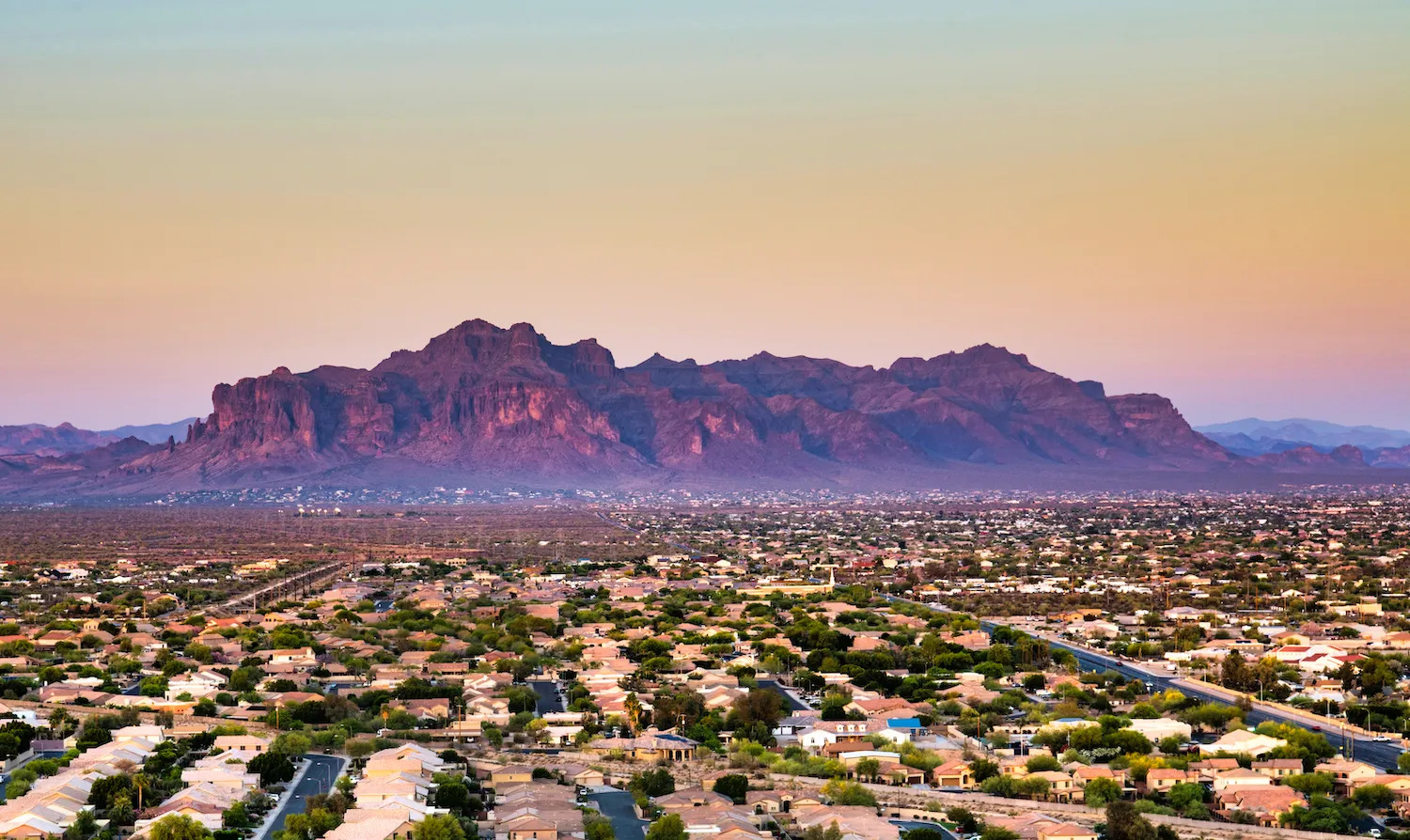
Quick Stats: Phoenix Q1 2026
Metric | Q1 2026 Data | Source |
Industrial absorption | 18.2M sq ft full-year 2025, strongest annual total since 2022 | |
Semiconductor commitment | Amkor Technology raised Peoria investment to $7 billion | |
Employment growth | 250,000+ jobs added 2019-2025, 11% rate, 2nd highest among large metros | |
New air route | First Phoenix nonstop to Asia: STARLUX Airlines to Taipei, 3x weekly | |
Banking expansion | BMO opened 15 new financial centers across Arizona in Q1 | |
New facility | KoMiCo opened $60M semiconductor facility in Mesa, 200+ jobs |
The Common Thread
Read the Q1 headlines in sequence, and a specific pattern emerges. The semiconductor supply chain required direct access to Taiwan, and a nonstop route from Taipei launched in January. That air connectivity strengthened Phoenix’s corporate site selection profile, and a financial services headquarters followed in February. The growing white-collar employment base those firms are adding made premium retail expansion viable, and internationally recognized brands entered the Valley in March. Each development made the conditions slightly more favorable for the next one.
This compounding dynamic is the clearest signal Q1 produced. Phoenix has spent several years adding individual growth drivers across semiconductors, logistics, financial services, and healthcare. Q1 2026 is the first quarter where the evidence of those drivers feeding into each other became visible at scale. The investment implication for Phoenix multifamily is direct: when a market’s growth sectors start compounding rather than simply coexisting, the employment base generating rental demand becomes more resilient to individual-sector disruptions. No single company exit or industry slowdown reverses a demand picture built across manufacturing, finance, aerospace, and consumer services simultaneously.
$47B+Combined semiconductor capital committed to the Phoenix metro as of Q1 2026, across TSMC’s $40B+ fabrication investment and Amkor Technology’s $7B Peoria facility. Sources: Business Journal, AZ Big Media |
The Markets We Track
Advanced Manufacturing and Technology
Q1 confirmed that Phoenix’s semiconductor cluster has crossed from anchor investment into supplier ecosystem formation, and that transition has specific implications for multifamily. Anchors like TSMC and Amkor generate large, concentrated employment clusters in defined corridors. The supplier tier forming around them, including KoMiCo’s $60 million Mesa facility, Fujifilm’s Mesa expansion, and KBR’s precision lab in Phoenix, generates jobs that are broader, more distributed across submarkets, and ramp faster than fab hiring. (Phoenix Business Journal, Business Journal, KBR Press Release) As of Q1 2026, both layers are active simultaneously in the Valley, which means the geographic range of workforce housing demand generated by the manufacturing cluster is widening.
Mesa’s Elliot Road Technology Corridor reached a density threshold in Q1, at which point it functions as a cluster rather than a collection of individual tenants. Workers at several facilities in the same corridor create compounding residential demand in adjacent neighborhoods. Chandler and Gilbert are absorbing spillover demand from workers who want proximity to the corridor without the industrial submarket premium. The occupancy and rent performance in value-add multifamily assets east and south of Mesa is being driven by this dynamic, and the Q1 announcements indicate it has more runway ahead.
INVESTMENT SIGNAL |
| When a corridor generates jobs from several independent companies within a two-mile zone, residential demand in adjacent submarkets no longer depends on any single employer. The Elliot Road cluster reached that point in Q1. |
Corporate and Financial Services
Pure Insurance established a regional headquarters in Scottsdale in February, adding a financial services anchor to one of the Valley’s strongest office submarkets. (Orion Investment Real Estate) Regional headquarters operations bring leadership, underwriting, client services, and operational roles that generate above-average household income and sustained residential demand in surrounding neighborhoods.
The Arizona Cardinals broke ground on a new headquarters and performance center in February. Owner Michael Bidwill described the project as “a generational, Arizona-first investment anchored by a world-class performance center and team headquarters.” (AZ Family) Professional sports facilities function as commercial anchors. Retail, dining, and mixed-use activity increases in the corridors surrounding new sports campuses as organizations deepen their operational presence.
BMO opened 15 new financial centers across Arizona in March in direct response to population growth and rising banking demand. (Phoenix Business Journal) Banks of BMO’s size run detailed demand forecasting before committing to 15 simultaneous openings. The Arizona expansion reflects their projection that population and business activity across the state will continue growing at a pace that justifies a broad physical presence.
INVESTMENT SIGNAL |
| A financial services headquarters, a professional sports facility, and a 15-branch banking network committing to the same market in one quarter is a forward read on where white-collar employment density is heading over the next five years. |

Infrastructure and Workforce
Grand Canyon University extended its development agreement with the City of Phoenix in February, continuing a partnership that has reshaped the neighborhoods surrounding the campus across multiple investment cycles. Councilwoman Guardado described the agreement as providing “the framework for responsible growth, infrastructure enhancements and ongoing engagement with neighborhood stakeholders.” (GCU News) University investment produces consistent, predictable economic output: stable employment, student housing demand, and a steady stream of workforce entrants entering the regional labor pool.
The Gateway District workforce and nonprofit hub advanced in March, with plans moving forward to centralize job training, community services, and employment resources near Sky Harbor International Airport. (What Now Phoenix) Major employers in semiconductor manufacturing and aerospace evaluate workforce infrastructure before finalizing expansion decisions. A coordinated training and services hub in a transit-accessible location adjacent to the Valley’s largest employment corridor signals that Phoenix is investing in the labor supply its anchor industries require.
Phoenix added its first nonstop route to Asia in January when STARLUX Airlines launched three-times-weekly service between Phoenix Sky Harbor and Taipei. (City of Phoenix) The direct connection resolved an operational gap for the semiconductor supply chain. TSMC and its Taiwanese supplier network previously required a connection through Los Angeles or San Francisco for executive travel and logistics coordination. A nonstop route to Taipei puts Phoenix on a short list of non-coastal U.S. metros with direct access to Asia, which carries weight in corporate site selection decisions.
INVESTMENT SIGNAL |
| Phoenix invested in workforce infrastructure on three time horizons simultaneously in Q1. Markets that plan that way deliver residential absorption that tracks employment growth steadily. Markets that do not tend to spike and correct. |
Population and Consumer Demand
Retail expansion in Q1 provided the clearest confirmation that Phoenix’s population growth is translating into real consumer spending. Trader Joe’s moved into North Phoenix, targeting a residential corridor where new housing development has been outpacing retail supply for several years. (ABC15) Din Tai Fung chose Scottsdale for its first Arizona location, a brand whose site selection process is rigorous enough that its entries function as independent market validation on submarket income and traffic patterns. (Phoenix Business Journal) Soul Fire Tacos opened in Scottsdale Airpark, where daytime employment density from the corridor’s corporate and tech tenants creates consistent restaurant demand. (Fabulous Arizona)
Rose Law Group reported that Phoenix’s housing market stayed resilient through Q1 despite elevated interest rates, with employment growth and in-migration sustaining residential demand. (Rose Law Group) Phoenix added 250,000 jobs between 2019 and 2025, an 11% increase, ranking second among large metros. For-sale absorption moderated as rates remained elevated and redirected demand into the rental market. That redirection is creating occupancy pressure on value-add multifamily assets in submarkets with concentrated employment growth.
INVESTMENT SIGNAL |
| Retail brands enter markets based on where their models project demand will be in 18 to 24 months. Q1’s entries were a forward bet on Phoenix population growth, not a response to existing demand. |
Submarket Watch
Mesa generated more named investment activity than any other Phoenix submarket in Q1 2026. The KoMiCo opening, Fujifilm’s expansion approval, Garmin’s Mesa Gateway facility, and the continued TSMC supplier activity along the Elliot Road Technology Corridor all concentrated in the same geographic zone within a single quarter. (Garmin) Density creates a condition where individual submarket tracking understates the actual employment impact: workers at several facilities within two miles of each other generate compounding residential demand in adjacent neighborhoods that does not show up clearly in any single announcement.
Chandler and Gilbert are the residential absorption submarkets to watch. Workers in the Elliot Road corridor who do not want to live in an industrial submarket are the primary demand driver for value-add multifamily in both cities, and Q1 added several hundred jobs to that pool. Scottsdale ran the quarter’s strongest corporate and retail activity outside the East Valley cluster, with Pure Insurance, Din Tai Fung, and sustained financial services investment reinforcing the submarket’s role as the Valley’s primary corporate address. The residential demand generated by Scottsdale’s corporate tenant base continues pushing south and west into the Tempe and Chandler submarkets, where workforce housing is priced within reach of financial services employees.

Investment Outlook
Three dynamics from Q1 are worth tracking into Q2 and the back half of 2026.
The first is the hiring pace around the semiconductor facilities. As those operations move closer to opening, the surrounding housing market feels the demand before any public report captures it. The West Valley and East Valley are where to watch first.
The second is the financial services cluster forming in Scottsdale and the Greater Phoenix area. White-collar employment concentrations of this type historically push rents in nearby workforce housing submarkets over the 12 to 24 months that follow. The demand is building before the market prices it in.
The third is longer range. The air connectivity, semiconductor depth, and financial services momentum coming out of Q1 are making Phoenix more competitive in corporate location decisions being made right now. The employment those decisions produce will reach Phoenix in two to three years. Q1 planted those seeds.
FAQ: Phoenix Multifamily Market – Q1 2026
What is driving Phoenix multifamily investment opportunities in 2026?
Three employment categories generated sustained housing demand in Q1 2026: semiconductor manufacturing and its supplier ecosystem across Mesa and Peoria, corporate headquarters growth in financial services and aerospace, and healthcare expansion. All three have wage profiles above regional averages and sustain durable occupancy over multiple years.
Which Phoenix submarkets showed the strongest investment signals in Q1 2026?
Mesa and the East Valley generated the most concentrated activity through the semiconductor and aerospace supply chain cluster along the Elliot Road Technology Corridor. Peoria and the West Valley absorbed demand from the Amkor Technology and TSMC anchor investments. Scottsdale led corporate office and premium retail activity, reinforcing its position as the Valley’s primary corporate address.
How does semiconductor investment in Phoenix affect the multifamily market?
Semiconductor roles at the fab and supplier level pay above regional wage averages and require large, stable workforces. As those workers enter the Phoenix market, they generate sustained rental housing demand in the submarkets nearest to the manufacturing corridors. Each new supplier facility near an anchor fab adds another layer to the same geographic zone, compounding the residential demand that follows.
How does Phoenix’s industrial absorption rate affect multifamily performance?
Phoenix absorbed 18.2 million square feet of industrial space in 2025, the strongest annual total since 2022. Industrial occupancy at that scale generates broad employment in logistics, operations, and supply chain management across Goodyear, Tolleson, and the West Valley. Those roles produce consistent workforce housing demand in the Class B multifamily submarkets closest to the distribution corridors.
Is the Phoenix housing market still absorbing population growth in 2026?
Yes. Rose Law Group reported that Phoenix’s labor market strength and continued in-migration sustained residential demand through Q1 2026. For-sale absorption moderated as interest rates held elevated, increasing pressure in the rental market. The underlying employment and population drivers that support rental housing remained intact through the rate environment.
Conclusion
Q1 2026 produced the clearest evidence yet that Phoenix’s growth sectors are compounding, not simply coexisting. Semiconductor investment reached a capital commitment level that few non-coastal markets see in a single quarter. Corporate headquarters growth spread across financial services, aerospace, and professional sports. Infrastructure investment covered near-term workforce development, medium-term banking capacity, and long-term corporate connectivity in the same 90 days. And retail expansion confirmed that consumer spending is tracking population growth across submarkets simultaneously.
For investors evaluating Phoenix multifamily investment opportunities through 2026, Q1 identified where employment density is concentrating, which submarkets are absorbing residential demand first, and why the demand profile supports value-add strategies in corridors adjacent to the Valley’s major employment anchors. The diversification is the durability. Q1 confirmed both remain intact.
For information on multifamily investment opportunities in the Phoenix market, visit rise48equity.com/location/arizona/phoenix/
Disclaimer: This report is published by Rise48 Equity for general informational and educational purposes only. It does not constitute investment advice, a solicitation, or an offer to buy or sell any security or investment product. The information contained herein is based on third-party sources believed to be reliable as of the date of publication; Rise48 Equity makes no representations or warranties as to the accuracy, completeness, or timeliness of this information. Past market trends and historical economic data referenced in this report do not guarantee future performance or results. Real estate investments involve significant risks, including the potential loss of principal. All investment decisions should be made based on your own independent due diligence and in consultation with qualified financial, legal, and tax advisors. Rise48 Equity is not a registered investment advisor. Nothing in this report should be construed as a recommendation to pursue any particular investment strategy.
About Rise48 Equity:
Rise48 Equity is a Multifamily Investment Group with local offices in Phoenix, AZ, Dallas, TX, and Charlotte, NC. “At Rise48 Equity, we provide opportunities for accredited and non-accredited investors to protect and grow their wealth and achieve passive cash flow. Our team brings expertise to acquire, reposition, and return capital to investors upon reaching our business plan. Through our research and strategically formed partnerships, we acquire commercial multifamily apartment properties, strategically add value to the properties, and create passive income for our investors through cash flow and profits from the sale.”
Ready to Explore Investment Opportunities in Phoenix?
If you’re looking to learn more about how you can achieve passive cash flow through Rise48 Equity’s multifamily investments in Phoenix, schedule a brief call with us today. Let’s discuss how we can help you grow your wealth through strategic real estate investments.
