


Real estate syndication is a legal structure that pools capital from many investors to acquire properties that would be difficult or impossible to buy individually. Knowing what “preferred return” means and how waterfalls distribute profits determines whether you evaluate deals accurately or chase marketing numbers. Most investors understand the concept but lack precision on the mechanics. That precision separates informed investors from those who lose money to misaligned incentives or hidden fee structures.
The structure involves two parties: general partners, who source, manage, and execute; and limited partners, who provide capital and receive distributions. The legal agreement between them specifies how profits are split, when distributions happen, and what triggers different payment tiers. This document controls everything. The business plan is marketing. The waterfall is your actual economics.
This content is provided for educational purposes only and does not constitute an offer to sell or a solicitation of an offer to buy any security. Any offering of securities by Rise48 Equity is made only by means of a private placement memorandum to investors who meet applicable eligibility requirements. This material contains forward-looking statements and hypothetical illustrations that are not guarantees of future performance.
The Two Core Roles: General Partner vs. Limited Partner
A real estate syndication requires two distinct roles with separate responsibilities and economic interests.
General Partner Role
The general partner (GP), also called the sponsor, sources the deal. This means identifying properties, evaluating markets, structuring financing, raising capital from investors, and managing all operations. The GP conducts due diligence, negotiates purchase terms, secures debt financing, oversees property management, executes the business plan (renovations, rent increases, operational improvements), manages tenant relations, and orchestrates the exit strategy through sale or refinance.
The GP takes operational risk. If the business plan fails, the sponsor’s capital and reputation suffer directly. The GP also contributes meaningful equity capital, typically 5-10% of total equity, creating alignment with investor interests (Proper Locating). This co-investment is critical. If the sponsor has money in the deal alongside yours, they’re motivated to execute the plan, not simply collect fees and move on.
The GP’s compensation comes from three sources: acquisition fees (typically 1-3% of purchase price), asset management fees (1-2% of invested equity annually), and profit participation above defined thresholds called the “promote.” The promote is where the GP’s primary economic upside lives.
Limited Partner Role
Limited partners (LPs) are the passive investors. You provide the bulk of equity capital, typically 90-95% of total equity raised (Proper Locating). In exchange, you receive quarterly or monthly distributions under the operating agreement, have limited voting rights (usually only on matters that would change the deal’s fundamental nature), and exit when the GP sells or refinances.
Your obligation is capital deployment and periodic review. You do not manage properties, approve individual tenant leases, or direct capital improvements. The operating agreement governs the entire relationship. This document specifies cash distribution rights, any voting rights, redemption terms, amendment procedures, and what happens if the sponsor dies or leaves.
The essential distinction is that the GP controls operations. The LP controls whether to invest and when to exit. Everything else flows from that division.
The Operating Agreement: Where Economics Actually Live
The operating agreement is the legal document that defines the partnership. It specifies how many classes of equity exist, how capital contributions relate to economic interests, when distributions occur, how the waterfall works, what happens in the event of a disagreement, and which actions require LP consent.
Unlike the business plan (which marketing shapes), the operating agreement defines your actual economics. Read the distribution section carefully. This section specifies the priority, timing, and formulas for every payment tier.
Three components are critical in the operating agreement:
Equity Ownership Structure: This determines what percentage of the deal you own. If you invest $100,000 in a $1 million equity raise, you typically own 10% of LP equity. Your ownership entitles you to 10% of LP distributions per the waterfall. The GP’s equity sits separately and receives distributions per its own waterfall tier.
Preferred Return Mechanism: This specifies the return you receive before the GP takes profits. Most syndications use an 8% preferred return, meaning you receive the first 8% on unreturned capital before the GP gets anything. This pref is usually cumulative, meaning that if the property generates only 6% in a given year, the missing 2% carries forward and accrues toward future payments.
Fee Structure: The operating agreement details all fees the sponsor charges: acquisition fees paid at close, asset management fees paid annually from operating cash flow, and disposition fees paid at exit. These fees are paid from LP capital or cash flow before distributions. Understand them fully. A sponsor charging 2% in annual asset management fees compresses your returns compared to one charging 1%.
The Waterfall: How Profits Actually Distribute
The waterfall is the priority system for distributing cash. Money flows through tiers. Each tier must be satisfied (or accumulate) before cash moves to the next level. Think of it as a staircase: each step captures water before it spills to the next.
Most real estate syndications use a four-tier or five-tier waterfall structure (InvOwn):
Tier 1: Return of Capital
In this tier, 100% of distributed cash goes to limited partners until they recover their initial investment. This provides downside protection. You do not “pay carry” on your own money. Only once you’ve received your full capital back does the waterfall move to profit-sharing tiers.
Example: You invest $100,000. In years 1-3, the property generates $150,000 in distributable cash flow. All $150,000 goes to you and other LPs until your original $100,000 is fully returned.
Tier 2: Preferred Return
Once capital is returned (or during operating years, on unreturned capital), you receive a preferred return. This is a cumulative annual percentage, typically 6-10%, paid to investors before the sponsor takes any profit participation (InvOwn).
Example: You have $100,000 still unreturned. The preferred return is 8%. You receive $8,000 annually in preferred distributions before the sponsor earns anything. If the property only generates $6,000 that year, you receive the full $6,000 and the missing $2,000 accrues (in a cumulative manner) for future payment.
Tier 3: Catch-Up (Sometimes)
Some syndications include a “catch-up” provision. Once LPs have received their full preferred return, the GP receives 100% of further distributions until the GP has caught up to a proportional share.
This exists because the preferred return creates a math problem. If you receive 8% on capital while the GP receives nothing, the GP’s effective carried interest becomes diluted. The catch-up corrects this temporarily. After the pref is satisfied, the GP might receive 100% of the next distributions until it reaches its target carry percentage.
Example: $100,000 investment with 8% pref. The deal generates $16,000 annually. First $8,000 goes to you (pref). The remaining $8,000 goes entirely to the GP (catch-up) until the GP has earned their proportional carry. Then it reverts to the promote split.
Catch-up provisions are more common in private equity than real estate, but appear in sophisticated multifamily syndications. When you see a catch-up, scrutinize how it’s calculated. Some catch-up structures shift significant economics to the GP that don’t appear in headline pref/promote terms (Proper Locating).
Tier 4: Promoted Splits
After preferred return (and any catch-up), cash above the pref splits between LPs and GP per the promote schedule. A simple structure uses a single 70/30 split (70% to LPs, 30% to GP). More sophisticated deals use tiered promotes that escalate with return levels.
Example: 70/30 split up to 12% LP IRR, then 60/40 from 12-18% IRR, then 50/50 above 18% IRR. This structure rewards sponsors for delivering exceptional performance while protecting investors at baseline returns.
The promote is where the sponsor’s economic upside lives. A well-designed waterfall means the GP earns significantly more when LPs earn significantly more. This alignment distinguishes a well-structured syndication from a simple fee-driven arrangement.
Preferred Returns: What They Actually Mean
A preferred return is a percentage of returns that LPs receive before the sponsor participates in profits. It’s not a guarantee. It’s a priority claim on cash flow.
Preferred returns typically range from 6-10% annually (InvOwn). An 8% preferred return is the market standard in 2026 institutional syndications. The exact percentage varies by risk profile and sponsor track record.
Cumulative vs. Non-Cumulative
Cumulative preferred returns accrue. If the property generates only 6% and the pref is 8%, the 2% shortfall carries forward. Future distributions satisfy accumulated pref before any promote kicks in. Most institutional syndications use cumulative prefs because they align interests: sponsors can’t skip paying investors in early years and make it up later.
Non-cumulative prefs do not accrue. If the property generates 6% and the pref is 8%, you receive the 6%, and the missing 2% disappears. This structure favors sponsors. Avoid non-cumulative structures unless the deal’s safety margin is exceptional.
Preferred Return is Not Guaranteed
This is critical. A preferred return is not a bond coupon. It’s a distribution priority, not a legal guarantee. If the property underperforms and generates insufficient cash flow, the pref may not be fully paid. Distributions depend on actual property performance.
This is why sponsor track record and market fundamentals matter. A sponsor with a history of meeting preferred returns across multiple deals signals execution capability. A sponsor operating in markets with strong job growth and balanced supply suggests the property will perform. Neither eliminates risk, but both reduce it.
How Distributions Actually Work
Cash distributions to investors happen on a set schedule: typically quarterly, sometimes monthly. The amount depends on actual property performance and the waterfall tier.
During Stabilization
In early years (often 12-24 months for value-add deals), the property may be undergoing renovations. Cash flow is often minimal or negative because renovation capital is being deployed. Distributions may be deferred. The business plan should specify when you expect to receive cash distributions and the conditions under which they might be delayed.
After Stabilization
Once the property stabilizes and rents have increased, sponsors typically distribute 70-85% of available cash flow quarterly, retaining 15-30% for reserves and contingencies (Angel Investors Network). The operating agreement specifies this percentage.
You receive a K-1 tax document annually showing your allocations of income, losses, and depreciation. Depreciation frequently shelters 60-80% of cash distributions from ordinary income tax, though the tax treatment varies by individual. Consult a tax advisor about your specific situation.
At Refinance or Sale
When the property is refinanced or sold, the waterfall activates in its full form. Debt is repaid first. Remaining proceeds are distributed per the waterfall: return of capital first, then preferred return accrual, then promote splits.
Example: Property purchased for $10 million with $7 million debt, $3 million equity. Refinanced five years later at $13 million value with $8 million new debt. The $5 million difference ($13M sale price less $8M debt) is distributable to equity holders. After debt payoff, $1 million goes to the return of capital (if any remains), accumulated pref is satisfied, catch-up (if any) activates, and then promote splits apply to the remaining amounts.
Fee Structures: The Hidden Return Drag
Sponsors charge fees outside the waterfall. These fees significantly reduce equity value and LP distributions.
Acquisition Fee: Paid at close, typically 1-3% of purchase price. On a $20 million acquisition, this is $200,000 to $600,000 paid from equity capital before the equity even reaches the property.
Asset Management Fee: Paid annually from operating cash flow, typically 1-2% of invested equity. On $7 million of LP equity, this is $70,000 to $140,000 per year that never reaches LP distributions.
Disposition Fee: Paid at exit from sale proceeds, typically 1-2% of sale price. On a $25 million sale, this is $250,000 to $500,000 from exit proceeds that LPs never see.
These fees are legitimate. Asset managers work hard. But understand them fully. A deal projecting a 14% IRR with 1% asset management fees produces lower net returns than the same deal with 1.5% fees. Many investors chase headline returns and overlook the impact of fees on net economics.
Ask sponsors: Are your fee ranges within market norms? Can fees be offset against the promote if the deal outperforms? These questions clarify fee transparency.
Multi-Tier Waterfall Example: The Math
Here’s a concrete example showing how a tiered waterfall works:
Deal Assumptions:
- LP Investment: $1,000,000
- GP Co-Investment: $200,000
- Total Equity: $1,200,000
- Waterfall Structure:
- Tier 1: Return of capital (100% to LPs)
- Tier 2: 8% cumulative preferred return to LPs
- Tier 3: 70/30 split up to 12% LP IRR (70% to LPs, 30% to GP)
- Tier 4: 60/40 split above 12% LP IRR (60% to LPs, 40% to GP)
Five-Year Outcome:
- Total cash distributed: $2,200,000
- Less capital returned to LPs: $1,000,000
- Remaining profit: $1,200,000
- Preferred return owed to LPs (8% × 5 years): $400,000
- Remaining after pref: $800,000
- Tier 3 split (70/30): $560,000 to LPs, $240,000 to GP
- Tier 4 split (60/40): $240,000 to LPs, $160,000 to GP
- Total LP distribution: $2,200,000 (100% capital + full pref + profit share)
- LP equity multiple: 2.2x ($2.2M return on $1M invested)
- GP total compensation: $400,000 (from promote tiers)
This example shows how the waterfall prioritizes LP returns while incentivizing sponsor performance. At baseline returns, LPs recover capital and receive pref. At higher returns, sponsors earn meaningful promote. Both parties benefit from hitting returns targets.
Important Disclaimer: Actual returns depend on property performance, market conditions, and sponsor execution. Past results do not guarantee future returns.
Alignment Signals: Separating Strong Structures from Weak Ones
A well-designed syndication waterfall signals alignment between GP and LP interests.
Please note: Structure and fee transparency are important, but they don’t alone determine success. Sponsor track record, market fundamentals, and execution capability matter equally. Evaluate all factors together.
Strong Structure Characteristics:
GP meaningful co-investment (5-10% of equity). The sponsor has “skin in the game” alongside you. If the deal fails, the sponsor loses money too.
Preferred return applies to unreturned capital. This protects investors if the property underperforms. You still collect your pref on the remaining capital even if it hasn’t yet been fully returned.
Cumulative preferred return. Shortfalls accrue and are paid from future distributions. The sponsor can’t skip paying investors early and make it up at exit.
Tiered promote structure. The GP earns more as investor returns exceed hurdles. This means sponsors are motivated to reliably hit baseline returns, then push for exceptional performance.
Full transparency on all fees. The offering documents clearly specify acquisition, asset management, and disposition fees. No surprise charges at exit.
Weak Structure Characteristics:
GP minimal co-investment (under 2% of equity). The sponsor earns fees without real capital at risk.
Non-cumulative preferred return. Investors can lose out on return accrual if cash flow is tight early on. This favors sponsors.
Single-tier promote. The GP earns the same percentage whether the deal produces 12% or 25% LP returns. This removes incentive to exceed baseline targets.
Catch-up provisions that heavily favor the GP. Some catch-up structures shift so much economics to sponsors that headline pref/promote terms don’t reflect actual distributions.
Vague fee disclosure. Important fees are buried in footnotes or not clearly specified upfront.
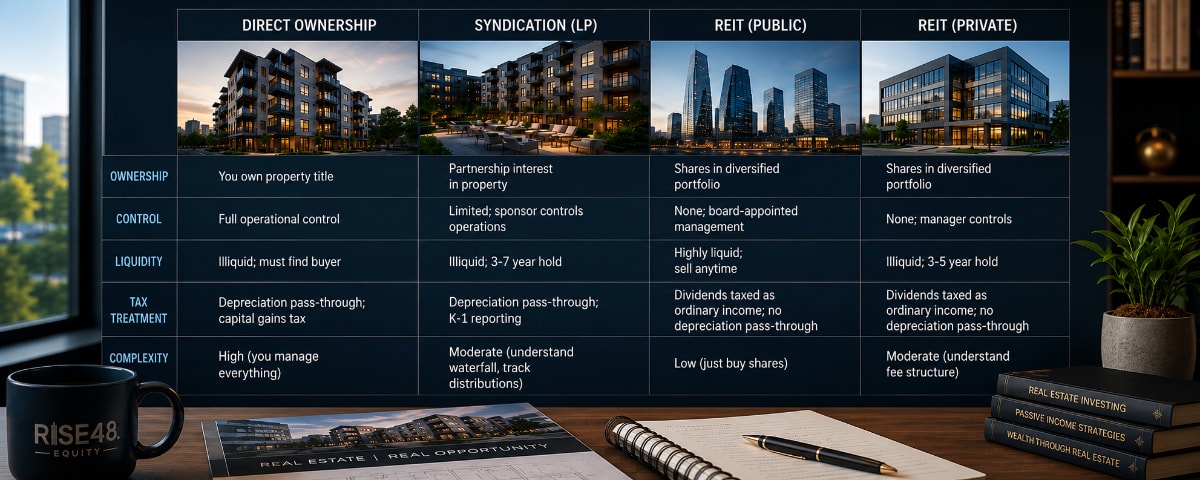
Real Estate Syndication vs. Other Investment Vehicles
How does syndication structure compare to alternatives?
Vehicle | Ownership | Control | Liquidity | Tax Treatment | Complexity |
Direct Ownership | You own property title | Full operational control | Illiquid; must find buyer | Depreciation pass-through; capital gains tax | High (you manage everything) |
Syndication (LP) | Partnership interest in property | Limited; sponsor controls operations | Illiquid; 3-7 year hold | Depreciation pass-through; K-1 reporting | Moderate (understand waterfall, track distributions) |
REIT (Public) | Shares in diversified portfolio | None; board-appointed management | Highly liquid; sell anytime | Dividends taxed as ordinary income; no depreciation pass-through | Low (just buy shares) |
REIT (Private) | Shares in diversified portfolio | None; manager controls | Illiquid; 3-5 year hold | Dividends taxed as ordinary income; no depreciation pass-through | Moderate (understand fee structure) |
Syndications offer unique advantages: ownership in specific properties you can evaluate, depreciation pass-through for tax efficiency, potential returns exceeding public REITs (which price in liquidity premium), and direct alignment with operator performance. The tradeoff is illiquidity and dependence on sponsor execution.
Understanding the Private Placement Memorandum
The private placement memorandum (PPM) is the legal disclosure document sponsors must provide before you invest. It details the property, the business plan, the waterfall, all risks, sponsor biography, financial projections, and offering terms.
Read the waterfall section carefully. This 5-10 page section describes how all the mechanics we’ve covered actually work in this specific deal.
Ask yourself:
- Is the preferred return cumulative or non-cumulative?
- What is the GP co-investment percentage?
- What are all the fees, and when are they paid?
- What is the promote structure, and at what return hurdles do tiers change?
- Is there a catch-up, and how is it calculated?
- What happens if the property underperforms? Are there any clawback provisions?
Do not invest without understanding these answers. The PPM has the details. Marketing materials have the story. You need both, but the PPM is your actual contract.

FAQ: Real Estate Syndication Structure
Is a preferred return guaranteed?
No. It’s a distribution priority, not a guarantee. Preferred returns are paid from actual property cash flow. If the property underperforms, the pref may not be fully distributed. This is why sponsor track record and market fundamentals are critical. They reduce the likelihood that actual cash flow will fall short of the pref.
What’s the difference between preferred return and hurdle rate?
A preferred return is a minimum annual percentage LPs receive before sponsors earn promote. A hurdle rate is a return threshold; once crossed, it changes the profit split in the sponsor’s favor. Some deals use both. Preferred returns protect downside. Hurdle rates escalate sponsor compensation as returns climb.
Can I lose money in a syndication if I’m an LP?
Yes. LPs have limited liability under the LLC or LP structure (meaning you don’t lose more than you invested), but you can lose your entire investment. If the property value declines materially, debt can exceed property value. In extreme cases, properties are foreclosed. Syndications are equity investments. Principal is at risk. This is why sponsor quality and deal fundamentals are essential factors.
What happens if the property underperforms and preferred returns aren’t paid?
If cumulative, unpaid pref accrues and is paid when cash flow improves or the property is sold. If non-cumulative, the missing pref is lost. Well-structured deals include reserves (retained cash flow) to handle temporary shortfalls. Very poor performance can result in capital calls, where sponsors ask LPs to contribute additional capital to cover debt service or critical repairs.
Why do some deals have a catch-up provision?
The catch-up corrects a math problem. If you receive 8% pref while the GP receives nothing, and the sponsor’s agreed carry is 20%, the sponsor’s effective carry becomes less than 20%. The catch-up gives the GP 100% of distributions in a band until the GP reaches their target carry percentage, then reverts to the promote split. This aligns the sponsor’s economics with the stated carry.
What’s the difference between a promote and carried interest?
They’re the same economic mechanic. “Promote” is used in deal-level syndications (one property). “Carried interest” is used in fund-level structures (portfolio of properties). The math is identical; the label reflects the vehicle structure.
Building Knowledge Through Waterfall Analysis
Understanding syndication structure separates investors who evaluate deals rigorously from those who chase projections. Most investors focus on headline IRR or preferred return percentage without understanding how those numbers actually materialize.
The waterfall is where the truth lives. It shows you the priority, the timing, and the alignment. A deal with an 8% preferred return but 100% catch-up favoring the sponsor may produce lower net returns than a deal with 7% pref and a tiered promote split.
The fee structure reveals whether the sponsor’s model is investor-aligned or fee-heavy. A sponsor charging 2% asset management plus acquisition fees plus disposition fees is building economics that compress your net returns regardless of performance.
Sponsor co-investment signals confidence. When a sponsor contributes 5-10% of equity alongside you, they’re saying their capital is at risk if execution fails. When a sponsor contributes less than 2%, they’re building economics where they profit even if investors suffer.
Start by mastering the waterfall. Ask sponsors to walk you through their specific structure tier by tier. Request the PPM section on distributions. Run the math yourself: given their projected returns, how much do you actually receive versus how much flows to promote and fees?
This disciplined analysis takes time. It’s uncomfortable work. It’s also what separates informed investors from those who discover later that projected 14% returns became actual 8% returns because the fee structure and waterfall mechanics compressed everything.
See our complete guide to passive multifamily investing for understanding how syndication structures deliver returns to passive investors, explore what multifamily syndication means for foundational concepts on how deals are built and operated, and review the top multifamily investment markets to understand market selection criteria that underpin sponsor performance.
About Rise48 Equity:
Rise48 Equity is a multifamily investment group with assets in Phoenix, AZ; Dallas-Fort Worth, TX; Charlotte, NC; Raleigh, NC; Durham, NC; and Chapel Hill, NC. The firm focuses on acquiring, repositioning, and operating value-add multifamily communities through a vertically integrated platform.
