Introduction: North Carolina Builds on a Strong Start to 2026
North Carolina continues to prove why it remains one of the most competitive and diversified economies in the country. February’s headlines highlight a powerful combination of financial services expansion, tech sector hiring, corporate investment, and workforce development initiatives that are reinforcing the state’s long-term growth trajectory.
From major banking leases in Charlotte’s South End to job-creating tech hubs and manufacturing expansions, the momentum is clear. Companies aren’t just entering the Carolinas, they’re doubling down. And local governments are responding with targeted incentives, infrastructure planning, and workforce programs designed to sustain that growth.
As we move further into 2026, North Carolina isn’t chasing opportunity, it’s actively shaping it
Charles Schwab Expands in South End with 110 East Lease
Financial giant Charles Schwab has signed a major lease at the 110 East tower in Charlotte’s South End, further cementing the district as a premier financial services hub
The move places Schwab in one of Charlotte’s fastest-growing office corridors an area known for walkability, mixed-use density, and proximity to the LYNX Blue Line. South End has evolved from a former warehouse district into a magnet for finance, fintech, and professional services firms seeking modern office space and strong talent access. (Business Journal)
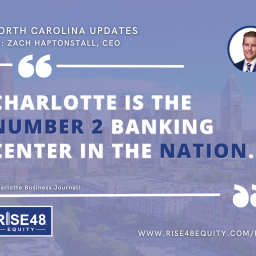
Schwab’s lease signals confidence in Charlotte’s workforce depth and long-term role as a banking capital. With Bank of America headquartered in the city and Truist maintaining a major presence, Charlotte continues to rival traditional financial centers. (Business Journal)
JPMorgan Chase Accelerates Charlotte Branch Growth
JPMorgan Chase is continuing its aggressive expansion across North Carolina, announcing plans to open five new branches in the Charlotte area in 2026 (Business Journal). The move reinforces both the bank’s long-term growth strategy in the Southeast and Charlotte’s position as one of the most important financial hubs in the country.
The expansion is part of Chase’s broader national branch buildout strategy, which has targeted high-growth markets with strong population inflows and business formation. Charlotte checks every box: sustained in-migration, rising household incomes, expanding suburban communities, and a deep commercial banking ecosystem. By adding new physical branches, Chase is signaling that Charlotte remains a priority growth corridor not just for digital banking, but for relationship-driven financial services. “The expansion signals continued momentum for Chase’s Charlotte buildout, where the bank already operates 28 branches and is adding to a statewide workforce that exceeds 1,000 employees.” (Business Journal).
This move also further solidifies Charlotte’s identity as a national banking capital. Already home to Bank of America’s headquarters and major operations for Truist, the city continues to attract investment from top-tier financial institutions. When a firm the size of JPMorgan Chase increases its retail footprint in a metro that is already financially saturated, it reflects strong belief in continued population and income growth. (Business Journal).
Beyond the banking industry, branch expansion contributes to broader economic momentum. New branches create jobs, drive commercial leasing activity, and increase lending capacity for entrepreneurs and homeowners. That capital circulation supports housing development, small-business growth, and consumer spending across the region.
Tech Industry Outlook Shows Continued Job Growth Across NC
North Carolina’s tech sector is expected to post continued job growth in 2026, according to recent industry outlook reporting, with gains projected across software, IT services, and emerging technology roles (Business Journal). The report highlights steady hiring momentum statewide, even as some national tech markets experience cooling.
The key takeaway for investors is stability. North Carolina’s tech growth is supported by established corporate employers, strong university pipelines, and a diversified base spanning Charlotte’s fintech ecosystem and the Research Triangle’s research-driven innovation. That balance reduces volatility compared to markets heavily dependent on venture-backed startups.(Business Journal).
“Charlotte’s job growth is phenomenal. The region added roughly 37,000 jobs between December 2024 and December 2025 far outpacing other North Carolina metros with technology embedded in financial services, enterprise software, retail and health-care sectors helping drive the growth” said Abernathy, managing partner of Economic Leadership. (Business Journal).
From a real estate and capital perspective, sustained tech hiring supports demand for housing, office space, and retail across Charlotte and other growth corridors. High-wage employment drives absorption and strengthens local tax bases, two critical indicators of long-term market durability. (Business Journal).

Coinbase Opens 150-Employee Customer Service Center in Charlotte
Digital asset platform Coinbase has opened a 150-employee customer service center in Charlotte, expanding its operational footprint in North Carolina (Charlotte Newsroom). The facility will support customer experience and account services, adding a meaningful number of jobs to the region’s growing fintech workforce. “We think there’s an incredible intersection of financial services and technology talent in the greater Charlotte area,” Chief people officer L.J. Brock said. Charlotte sits among the nation’s top banking hubs. Coinbase runs with more than 4,000 workers worldwide, including teams in San Francisco and New York City. (Charlotte Newsroom)
While the announcement centers on customer support roles, the broader signal is more significant. Coinbase’s decision to invest in Charlotte reflects confidence in the city’s financial services infrastructure, workforce depth, and cost advantages compared to coastal tech hubs. Charlotte’s established banking ecosystem creates a natural environment for companies operating at the intersection of finance and technology.
Coinbase’s expansion demonstrates that Charlotte is not just attracting legacy financial institutions, it is also becoming a landing spot for next-generation financial platforms. That layered growth is exactly what supports long-term economic resilience and investment confidence. (Charlotte Newsroom).
Siemens Energy Expands Charlotte Operations
Siemens Energy is expanding its operations in Charlotte, adding new jobs and reinforcing its long-term commitment to the region (City of Charlotte). The expansion supports growing demand across power generation, grid modernization, and energy infrastructure projects, sectors that are becoming increasingly critical nationwide.
Charlotte has long been a strategic hub for energy and advanced manufacturing companies, and Siemens Energy’s growth strengthens that positioning. The company’s investment reflects confidence in the region’s skilled engineering workforce, logistics connectivity, and business-friendly environment. North Carolina’s combination of technical talent and operational efficiency continues to attract global industrial firms looking to scale. (City of Charlotte).
Siemens Energy’s expansion underscores a broader theme for North Carolina in 2026: growth is diversified. With finance, technology, and now energy manufacturing all expanding simultaneously, Charlotte continues to demonstrate why it remains one of the Southeast’s most durable and investable markets.
Pentax Medical Connects Innovation at The Pearl
Pentax Medical is expanding its presence at The Pearl, Charlotte’s emerging medical innovation district, through its Connect Labs initiative (Charlotte Business Journal). The company’s move further activates the district as a collaborative hub for medical device development, research, and healthcare technology.
The Pearl, anchored by Atrium Health and Wake Forest University School of Medicine, was designed to cluster education, clinical research, and private-sector innovation in one walkable environment. Pentax Medical’s involvement strengthens that ecosystem, adding global industry participation to what is quickly becoming one of the Southeast’s most significant healthcare innovation corridors.(Charlotte Business Journal).
For investors, this is a meaningful signal. Innovation districts tend to drive durable demand for Class A office, lab space, multifamily housing, and experiential retail. When global medical device firms embed themselves within these districts, it validates long-term institutional confidence in the market.(Charlotte Business Journal).
More broadly, Pentax’s expansion reinforces Charlotte’s economic diversification. The city is not solely dependent on banking; it is actively building a life sciences and medical technology cluster that complements its financial base. That layered growth model enhances resilience one of the most important characteristics investors look for in a high-performing market.

Workforce Investment and Hiring Incentives Strengthen Growth
Local leaders across North Carolina are reinforcing economic momentum with targeted workforce initiatives. In Mecklenburg County, officials approved $600,000 in hiring incentives to support job creation and help employers expand operations (WSOC-TV). The funding is designed to offset onboarding and training costs, ensuring that companies choosing to grow in the region can scale efficiently.
At the same time, reporting out of Raleigh highlights surging demand for frontline and essential workers, as employers compete to fill roles across healthcare, hospitality, logistics, and public services (Hoodline). The tight labor environment underscores just how strong job growth has been statewide.
For investors, this dynamic matters. Strong hiring demand signals economic expansion—but proactive workforce investment ensures that growth remains sustainable. When counties step in with incentives and training support, they reduce friction between employer demand and labor supply. That alignment protects long-term economic stability.
Additionally, workforce development is one of the clearest indicators of a durable market. North Carolina is not simply attracting companies, it is actively building the infrastructure to support them. That forward-thinking approach strengthens business confidence, supports income growth, and reinforces why Charlotte and the broader state remain compelling markets for long-term investment.
Raleigh and State Capitals Recognized for Livability
Raleigh earned national recognition in a recent ranking of the best U.S. state capitals to live in, highlighting its affordability, quality of life, and economic opportunity (New York Post). The ranking evaluated factors such as cost of living, job market strength, amenities, and overall desirability areas where Raleigh continues to perform well.
This type of recognition reinforces what long-term investors already understand: livability drives migration, and migration drives demand. Raleigh’s combination of strong employment growth, access to higher education institutions, and relatively attainable housing compared to coastal markets continues to attract both young professionals and families.
For real estate markets, livability rankings are more than headlines, they are leading indicators. Inbound migration supports multifamily absorption, retail growth, and infrastructure expansion. As more households relocate for both career and lifestyle advantages, the economic base broadens.
Raleigh’s recognition underscores a core strength of North Carolina’s growth story: it offers economic opportunity without sacrificing quality of life. That balance is one of the most powerful drivers of sustainable, long-term investment performance.
Conclusion: North Carolina’s Balanced Growth Model Continues to Deliver
February’s developments make one thing clear: North Carolina’s growth is not being driven by a single headline industry, it is being powered by diversification. Financial services expansion in Charlotte, steady tech hiring across the state, energy and advanced manufacturing investment, and innovation growth at The Pearl all point to a layered and resilient economy.
That balance is critical from an investment perspective. Markets that rely too heavily on one sector are vulnerable to cyclical swings. North Carolina, by contrast, continues to build strength across banking, fintech, healthcare innovation, energy, and technology. Each sector reinforces the others, creating a stable employment base and consistent demand for
About Rise48 Equity:
Rise48 Equity is a Multifamily Investment Group with local offices in Phoenix, AZ, Dallas, TX, and Charlotte, NC. “At Rise48 Equity, we provide opportunities for accredited and non-accredited investors to protect and grow their wealth and achieve passive cash flow. Our team brings expertise to acquire, reposition, and return capital to investors upon reaching our business plan. Through our research and strategically formed partnerships, we acquire commercial multifamily apartment properties, strategically add value to the properties, and create passive income for our investors through cash flow and profits from the sale.”
Discover the Future of Investment with Rise48 Equity
Unlock the potential of passive cash flow through Rise48 Equity’s Charlotte multifamily investments. Speak with our experts to learn how you can grow your wealth and achieve your financial goals by scheduling a personalized consultation today.