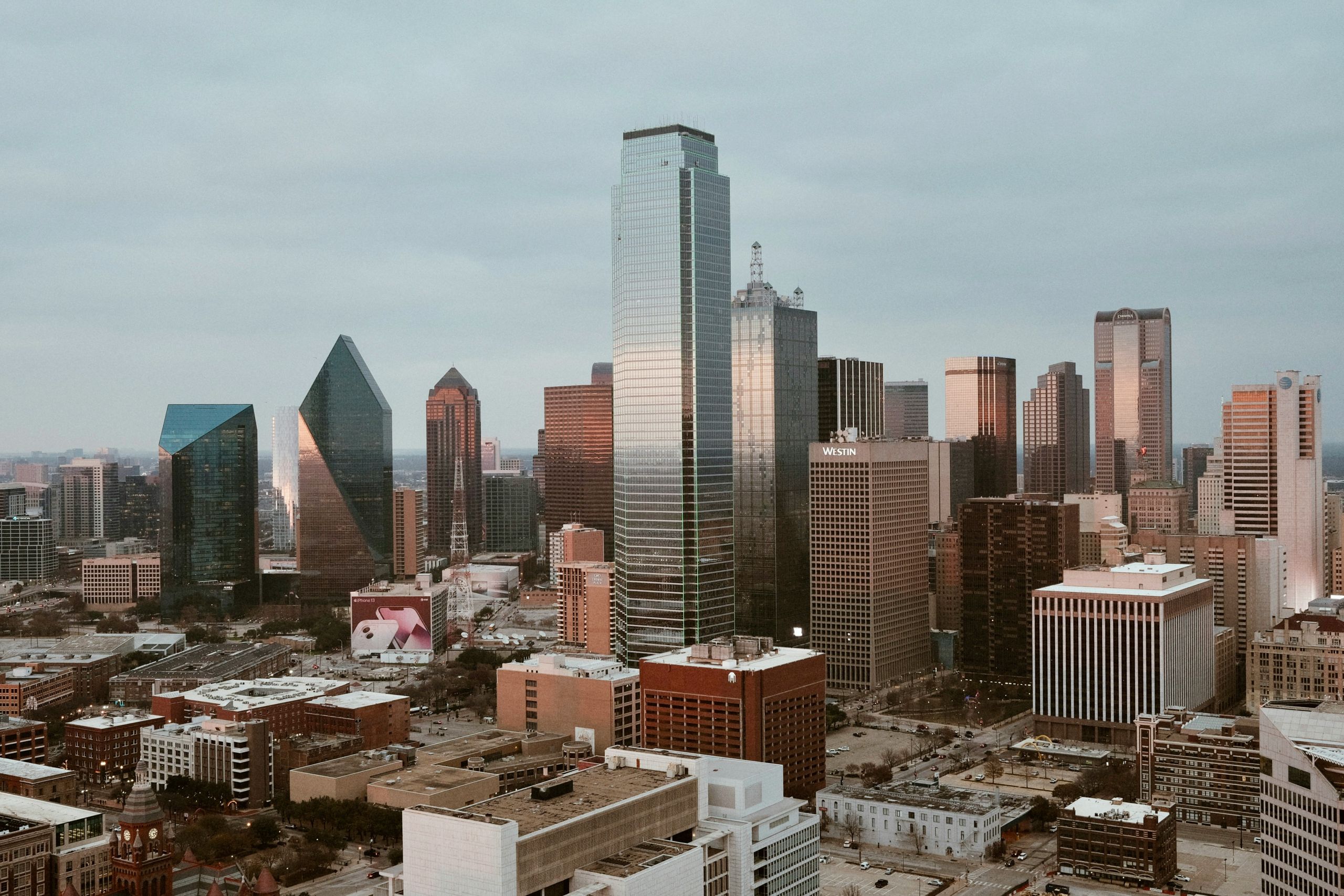
Texas’s Dallas-Fort Worth region delivered a month of contrasts this July. The city of Dallas confronted its first population decline since the pandemic even as the broader metro continued to post some of the strongest job, leasing, and manufacturing numbers in the country. Corporate investment kept flowing into North Texas, from a new aerospace maintenance hub in Fort Worth to a major manufacturing campus in McKinney. Office and apartment markets, meanwhile, showed clear signs of tightening after several years of heavy new supply. The result is a region still expanding rapidly on nearly every measure, even as its urban core grapples with a more complicated growth story.
Population Shifts and Dallas’s Urban Core
Dallas’s population fell for the first time since the pandemic this year, even as the broader Dallas-Fort Worth region grew at five times the city’s rate over the past five years (The Texas Tribune). Several suburban cities, including Fort Worth, Frisco, McKinney, and Denton, each added more residents than Dallas since 2020. The shift comes as AT&T prepares to relocate its downtown headquarters to a large new campus in Plano, and as the Dallas Stars hockey franchise plans a similar move, both drawn in part by local incentive packages. Dallas County Judge Clay Jenkins offered a blunt assessment of the trend.
“We’re a bug floating in a sink of water, and for the first time, the water didn’t rise, the water went down a little bit. We need to deal with the fact that the sink has a leak.”
Clay Jenkins, Dallas County Judge
Even so, the report noted signs of resilience in the urban core. A major investment bank is weighing a proposed 1.3 billion dollar office tower that could bring nearly 5,000 jobs downtown, and more than 1,100 new apartments have been added since 2020 through office-to-residential conversions. The city also faces a projected budget shortfall tied to slower growth, adding pressure on local officials to attract new investment back to the core. Business leaders and demographers quoted in the coverage described the shift less as decline than as a broader regional rebalancing, with Dallas increasingly functioning as one hub among several rather than the region’s undisputed center of gravity.
Advanced Manufacturing and Industrial Investment
Fort Worth’s AllianceTexas development added more than 2,100 jobs this month with the opening of two major manufacturing facilities (D Magazine). A German aerospace firm opened a large aircraft engine maintenance facility at Alliance Airport, while a Taiwanese electronics manufacturer opened an automated assembly plant nearby. Since 1989, the development has drawn more than 600 companies and tens of billions of dollars in regional economic impact. Bill Burton, an executive vice president at developer Hillwood, described the pace of activity on the campus.
“We are developing more than we’ve ever developed in our history. It’s an exciting moment in time.”
Bill Burton, Executive Vice President, Hillwood
Governor Greg Abbott separately announced that an electronics manufacturer will build a new North American headquarters and advanced manufacturing campus in McKinney (Office of the Texas Governor). The initial phase calls for an investment of more than 300 million dollars and 500 jobs, with the total project expected to grow significantly beyond that as it scales. State incentives, including a grant from the Texas Enterprise Fund, supported the deal.
Caterpillar also expanded its workforce investment in the state this month, launching the Texas phase of a five-year, 100 million dollar national initiative aimed at training workers for advanced manufacturing roles (Caterpillar Inc.). The program reflects a broader push among manufacturers to address skilled labor shortages as new facilities come online across North Texas, with an initial allocation directed toward technician training partnerships with community colleges and workforce boards.
Adding to the statewide manufacturing picture, Toyota announced a 3.6 billion dollar investment to add a second assembly line at its San Antonio plant, creating 2,000 jobs and nearly doubling the plant’s annual vehicle capacity (Click2Houston). While centered outside North Texas, the investment reinforces the broader climate of manufacturing expansion drawing companies to the state.

Office Market Momentum
Dallas-Fort Worth’s office market posted its strongest first half in several years, with leasing activity up 13 percent from a year earlier and available space shrinking notably (D Magazine). Major leases signed during the period included a large insurance company relocation to Richardson and a full-building lease in Las Colinas, alongside a headquarters relocation from California to Frisco.
Separate data from Avison Young showed the metro posting more than a million square feet of positive net absorption in the second quarter, with trophy and top-tier office buildings capturing nearly three-quarters of all leasing activity (Avison Young). The continued flight to quality suggests tenants remain willing to pay a premium for newer, well-located space even as overall availability stays elevated.
A third report put second-quarter leasing activity at 4 million square feet, up nearly 24 percent year over year, with the North Dallas Corridor leading all submarkets and accounting for roughly a quarter of the quarter’s total volume (Allwork.Space). Average asking rents for top-tier space rose to nearly 39 dollars per square foot, reflecting sustained demand for premium office product across the metro even as overall market-wide availability remains above pre-pandemic norms.
Multifamily Housing and Population-Driven Demand
The national apartment market turned a corner this year, with demand outpacing new supply for the first time since early 2022, and Dallas-Fort Worth stood out as one of the strongest performers (Cushman & Wakefield). The metro absorbed more than 18,000 units in the first half of the year, ranking among the top Sun Belt markets. Sam Tenenbaum, head of multifamily insights at Cushman & Wakefield, described the shift underway nationally.
“The apartment market is no longer defined by new supply pressures. Construction is slowing, demand has remained remarkably resilient and vacancy is now moving lower. That’s a meaningful shift from the conditions that shaped the market over the past several years and points to improving fundamentals as the pipeline continues to thin.”
Sam Tenenbaum, Head of Multifamily Insights, Cushman & Wakefield
Capital markets activity followed suit, with lenders arranging nearly 96 million dollars in financing for a 626-unit Texas multifamily portfolio this month (Cushman & Wakefield). The financing is a sign of continued investor appetite for apartment assets even as the broader market absorbs recent supply. Fort Worth also saw new development activity, with a 71 million dollar, nearly 300-unit affordable housing project breaking ground near the historic Stockyards district as part of a larger planned mixed-use redevelopment (The Real Deal). The project is expected to anchor a broader district that will eventually include a hotel and additional retail space, though a larger planned second phase of Stockyards redevelopment remains delayed amid an ownership dispute.
Infrastructure and Public Investment
Fort Worth continued investing in neighborhood infrastructure this month, beginning a 2.6 million dollar sidewalk improvement project in the city’s southeast Stop Six neighborhood, funded through a voter-approved bond program (Fort Worth Report). The project is intended to improve pedestrian safety and accessibility along a stretch of roadway that had lacked continuous sidewalks.
Dallas Fort Worth International Airport also advanced upgrades to its public safety infrastructure this month, including a multimillion-dollar project expanding security screening capacity and renovating cargo logistics space (Fort Worth Report). The work is part of the airport’s broader long-term capital improvement plan, which continues to expand the facility’s cargo and logistics capacity alongside passenger-focused upgrades.
Labor Market Strength
Texas’s job market continued its expansion this month, with the state adding more than 43,000 nonfarm jobs and nearly 178,000 jobs over the year, outpacing the national growth rate (Texas Workforce Commission). Professional and business services led monthly job gains, even as the state’s unemployment rate ticked up slightly. Joe Esparza, chairman of the Texas Workforce Commission, credited the state’s employers and workforce system for the sustained growth.
“Texas’ continued job growth is a testament to the strength of our employers and robust workforce development system. The addition of more than 177,000 jobs over the year reinforces Texas’ reputation among employers as the best place to start and grow a business.”
Joe Esparza, Chairman, Texas Workforce Commission
Regional data told a similar story in Dallas-Fort Worth specifically, where the metro added nearly 25,000 jobs over the year, led by professional and business services along with trade and transportation (PrideStaff Dallas). Manufacturing was the one notable area of softness, posting a modest decline even as most other sectors expanded.
Conclusion
Dallas-Fort Worth’s July underscored a region growing at two different speeds: a core city adjusting to slower population gains and corporate departures, and a broader metro still expanding rapidly across manufacturing, office leasing, and apartment demand. Job growth across North Texas continued to outpace the national average, and capital kept flowing into industrial and multifamily projects even as office markets tightened for the best available space. The month’s developments suggest the region’s growth story remains intact, even as its center of gravity continues to shift toward the suburbs.
About Rise48 Equity:
Rise48 Equity is a Multifamily Investment Group with local offices in Phoenix, AZ, Dallas, TX, and Charlotte, NC. “At Rise48 Equity, we provide opportunities for accredited and non-accredited investors to protect and grow their wealth and achieve passive cash flow. Our team brings expertise to acquire, reposition, and return capital to investors upon reaching our business plan. Through our research and strategically formed partnerships, we acquire commercial multifamily apartment properties, strategically add value to the properties, and create passive income for our investors through cash flow and profits from the sale.”
Since 2019, Rise48 Equity has completed over $2.4 Billion+ in total transactions and currently has $2 Billion assets under management located in Arizona, Texas, and North Carolina. All of the company’s assets under management are managed by Rise48 Equity’s vertically integrated property management company, Rise48 Communities.