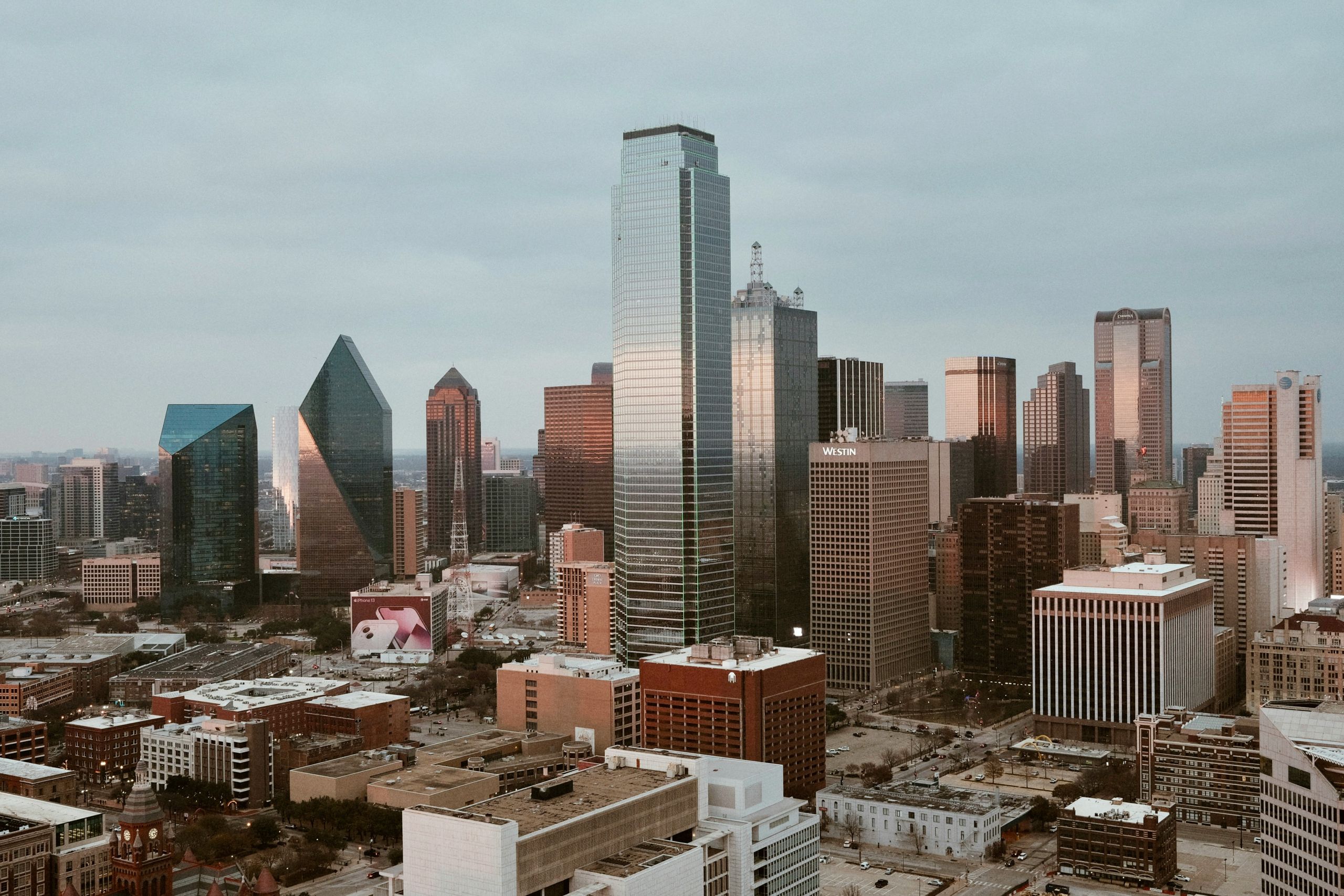
The Dallas-Fort Worth region kept adding corporate headquarters, defense manufacturing, and aviation investment this month, reinforcing North Texas’s position as one of the country’s most active economic development markets. Morgan Stanley’s decision to build a major new hub in Dallas topped a month of corporate relocation news, while a new academic study quantified just how much economic activity flows through the region’s largest airport.
Arlington and Fort Worth both landed new manufacturing and incentive wins, even as a data center proposal in Westlake ran into legal and community resistance. Commercial real estate data showed the region’s apartment market rebalancing after several years of heavy construction, and statewide housing figures pointed to a market stabilizing after a period of softer prices. Here is what shaped the Texas market this month.
Corporate Relocations and Financial Sector Expansion
Dallas landed one of the year’s most significant financial sector relocations this month. Morgan Stanley chose Dallas over a competing Georgia site for a new hub expected to support thousands of jobs over time, with the city approving an incentive package to help secure the project. The move adds to Dallas’s growing reputation as a magnet for financial services firms relocating from higher-cost coastal markets. The project is planned in phases, with an initial office lease followed by a larger build-to-suit tower (WBAP News).
“Morgan Stanley’s engagement with Dallas speaks to the strength of our financial services ecosystem, and I look forward to welcoming the firm to Y’all Street. We have worked hard to make Dallas America’s most pro-business city.”
Eric Johnson, Mayor of Dallas
Dallas’s investment community also notched a win this month. Broadwing Capital Management closed its inaugural fund at $440 million in total commitments, exceeding its $350 million target and its hard cap. Founded in 2022, the firm invests in founder-, family-, and operator-owned manufacturing and services businesses in the lower middle market, and has already deployed capital across six platform investments. The oversubscribed raise stands out in a difficult stretch for first-time managers and points to continued investor appetite for Texas-based private equity strategies (Dallas Innovates).
Aviation, Defense and Advanced Manufacturing
A new academic study put a number on just how much the region’s aviation industry contributes to the North Texas economy. Texas Christian University researchers found that American Airlines’ Dallas-Fort Worth hub supports roughly $70 billion in annual economic activity and more than 350,000 jobs across the region, underscoring aviation’s role in attracting corporate headquarters and investment to North Texas. The study noted the region has landed more than 100 corporate headquarters relocations since 2018 (American Airlines Newsroom).
“The value of our hub extends far beyond the airport. By connecting North Texas to hundreds of destinations around the world, we’re helping attract investment, support jobs, strengthen local businesses and position this region to compete on a global stage.”
Robert Isom, CEO, American Airlines
Fort Worth added a defense manufacturing win of its own this month. City council approved an incentive package for Mach Industries, a drone and defense technology manufacturer, to build a new plant at the AllianceTexas development. The project is expected to bring more than 1,000 jobs paying above the local average wage, adding to Fort Worth’s growing base of aerospace and defense manufacturers (Fort Worth Report).
Infrastructure spending at Dallas-Fort Worth International Airport also advanced this month. The airport board approved hundreds of millions of dollars in new terminal renovation and baggage system contracts as part of a broader multibillion-dollar capital improvement program, continuing years of steady expansion at one of the country’s busiest airports. The upgrades are designed to keep pace with passenger growth well into the next decade (Community Impact Newspaper).
Data Center Development and Community Response
Not every large infrastructure project moved forward smoothly this month. A Tarrant County court temporarily blocked a town council vote on a large data center campus in Westlake after nearby residents and a homeowners association sued to stop it, adding North Texas to the growing list of markets where data center growth is meeting local resistance. The proposed agreement had included a developer payment toward local infrastructure upgrades, underscoring the financial trade-offs municipalities are weighing as they court large power users (Fort Worth Report).

Commercial and Residential Real Estate Trends
The region’s apartment market showed signs of rebalancing after several years of heavy construction. Industry forecasts point to falling vacancy and modest rent growth as new deliveries slow sharply from their 2024 peak, supported by North Texas adding more new residents than any other metro in the country over the past year. Brokers pointed to sustained population growth, corporate expansion, and employment gains as the key drivers of long-term apartment demand. Some analysts expect the recovery to be uneven, with certain submarkets absorbing new supply faster than others (D Magazine).
Commercial development stayed active across several North Texas submarkets this month. A new hotel topped out in Plano’s Legacy District, a Fort Worth mall began its conversion into a large logistics campus, and an air taxi company signed its first North Texas lease at AllianceTexas, part of a broader wave of hospitality, industrial, and advanced mobility projects moving forward across the Metroplex (D Magazine).
Statewide housing data suggested a market finding its footing. The Texas Real Estate Research Center at Texas A&M University reported that statewide home sales rose in June compared with a year earlier, while the Fort Worth-Arlington submarket posted a second consecutive month of year-over-year price gains, even as the Dallas-Plano market showed only tentative signs of stabilizing after a period of price declines. Statewide inventory remained near a five-month supply, keeping the market roughly balanced between buyers and sellers (Texas Real Estate Research Center).
Economic Development and Civic Investment
Arlington’s economic development team earned national recognition this month. The Arlington Economic Development Corporation won three international awards from the International Economic Development Council, including recognition for a major manufacturing facility at Arlington Municipal Airport and a local business certification program that has helped dozens of local companies win new contracts. IEDC’s president said the city’s team was leading the field of excellence in economic development (City of Arlington, TX).
Plano voters will get the final say on one of the region’s largest proposed developments. The city council voted to send a funding plan for a roughly $3 billion mixed-use development, anchored by a new Dallas Stars arena, to the November ballot. The financing plan relies on hotel, rental car, and admissions taxes rather than a property tax increase, and would also draw on new commercial tax revenue generated by the project itself (CBS News Texas).
Fort Worth, meanwhile, took a closer look at how it distributes federal community development funding. A review of the city’s block grant program highlighted both successes and shortcomings in how federal community development funds have reached local nonprofits in recent years (Fort Worth Report).

Workforce, Education and the Innovation Economy
Texas’s labor market cooled slightly in July even as the broader outlook remained positive. The Federal Reserve Bank of Dallas projected the state would add more than 240,000 jobs in 2026, even after a slight monthly dip driven by softness in construction, finance, and manufacturing employment. Professional and business services and healthcare continued to add jobs, partially offsetting the softer sectors (Federal Reserve Bank of Dallas).
“Texas employment fell in July, bringing year-to-date job growth down to 1.6 percent, below the state’s long-run average of 2 percent. Nevertheless, Texas job growth has remained surprisingly strong given ongoing labor supply constraints.”
Luis Torres, Senior Business Economist, Federal Reserve Bank of Dallas
Fort Worth’s downtown innovation district took a major step forward this month. Texas A&M University System opened the first academic building at its new downtown Fort Worth campus and broke ground on a second research building, with officials projecting the completed campus will support tens of thousands of jobs and billions of dollars in annual economic activity (The Texas A&M University System News).
“This is not simply another downtown building or a collection of academic programs. It is a place where a student can meet a future employer, a researcher can sit across the table from a company facing a real problem and a good idea can become a product, a business or a job.”
Glenn Hegar, Chancellor, The Texas A&M University System
Dallas’s venture capital ecosystem also had a strong month. Astromech, a biotechnology company spun out of Dallas-based Colossal Biosciences, raised $20 million to continue applying artificial intelligence to evolutionary biology research, bringing its total funding to $60 million (Dallas Innovates).
Conclusion
Texas’s August headlines reinforced Dallas-Fort Worth’s position as one of the nation’s most active corporate relocation and economic development markets. Morgan Stanley’s decision to build a major hub in Dallas, alongside continued private equity fundraising and venture capital activity, points to sustained financial sector momentum in the region.
Aviation and defense manufacturing remained key economic pillars, with a new study quantifying the outsized impact of the region’s largest airport even as infrastructure investment continued at DFW International. Not every project advanced without friction, as the Westlake data center dispute showed local resistance is shaping how large-scale digital infrastructure gets built in North Texas. Real estate data suggests the region’s apartment and housing markets are moving toward a steadier, more balanced footing after several years of rapid construction and price volatility.
About Rise48 Equity:
Rise48 Equity is a Multifamily Investment Group with local offices in Phoenix, AZ, Dallas, TX, and Charlotte, NC. “At Rise48 Equity, we provide opportunities for accredited and non-accredited investors to protect and grow their wealth and achieve passive cash flow. Our team brings expertise to acquire, reposition, and return capital to investors upon reaching our business plan. Through our research and strategically formed partnerships, we acquire commercial multifamily apartment properties, strategically add value to the properties, and create passive income for our investors through cash flow and profits from the sale.”
Since 2019, Rise48 Equity has completed over $2.4 Billion+ in total transactions and currently has $2 Billion assets under management located in Arizona, Texas, and North Carolina. All of the company’s assets under management are managed by Rise48 Equity’s vertically integrated property management company, Rise48 Communities.